We're here to help: Send Inquiry

Inflatable tents have become increasingly popular for camping, glamping, outdoor events, emergency shelters, exhibitions, and commercial activities. However, many buyers still hesitate because of outdated information or misconceptions.
As a professional manufacturer of commercial inflatable PVC tents, we've spoken with thousands of customers worldwide. Surprisingly, many first-time buyers ask the same questions—and most are based on myths rather than facts.
In this guide, we'll explain the 10 most common inflatable tent misconceptions and reveal what actually matters when choosing a high-quality inflatable tent.
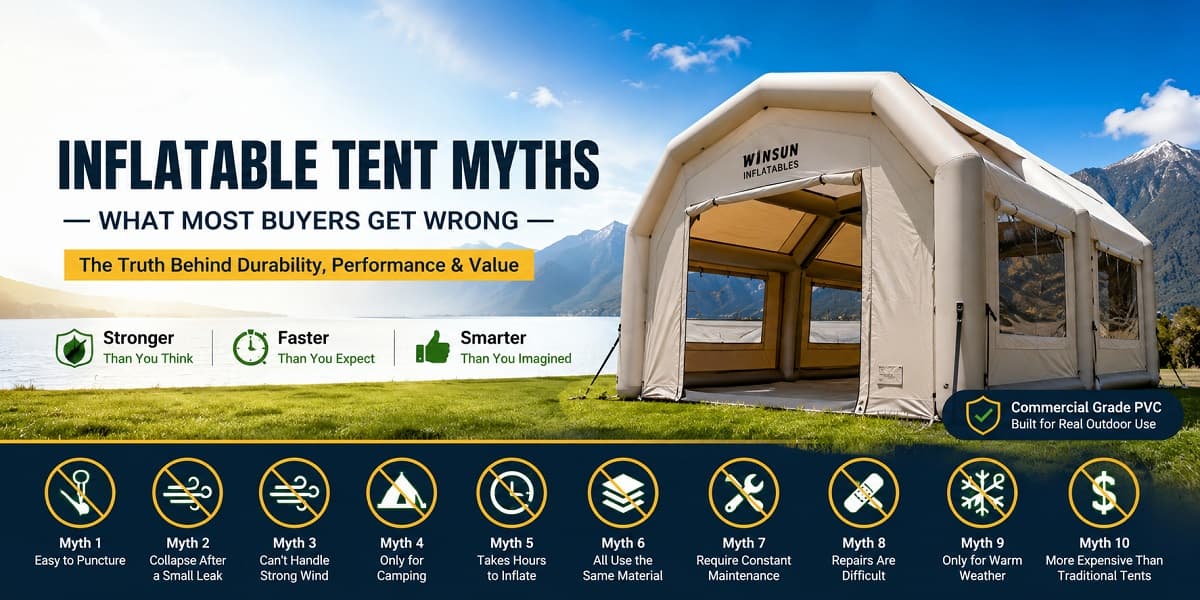
Many people imagine inflatable tents as oversized balloons.
They are not.
Commercial inflatable tents are manufactured using reinforced PVC-coated fabric (PVC tarpaulin), which is specifically engineered for heavy-duty outdoor applications.
The material offers:
Even if the fabric contacts branches, gravel, or rough ground during normal use, it is highly unlikely to puncture.
Professional-grade PVC inflatable tents are far more durable than most traditional camping tents made from lightweight fabrics.
This misconception comes from inflatable toys.
Commercial inflatable tents use two different air systems:
These tents remain inflated by a quiet electric blower.
If minor air leakage occurs, the blower continuously compensates for pressure loss.
Ideal for:
These tents are inflated once and then sealed.
The air chambers are independent.
Even if one chamber loses pressure, the remaining structure stays stable, giving users plenty of time to repair or re-inflate the damaged chamber.
Modern designs prioritize safety and redundancy.
A properly installed inflatable tent is surprisingly stable.
Unlike rigid metal poles, inflatable air beams absorb wind energy by flexing slightly instead of transferring all stress to a fixed frame.
Professional inflatable tents include:
When installed according to instructions, commercial inflatable tents can withstand demanding outdoor conditions.
As with any temporary shelter, extremely severe weather requires dismantling the tent for safety.
Camping is only one application.
Today inflatable tents are widely used for:
Their quick installation makes them attractive for almost any temporary outdoor structure.
This is one of the biggest surprises for first-time users.
Most inflatable tents can be installed much faster than traditional frame tents.
Approximate setup times:
| Tent Size | Typical Setup Time |
|---|---|
| Small camping tent | 3–8 minutes |
| Family tent | 5–10 minutes |
| Commercial event tent | 10–20 minutes |
| Large exhibition tent | 20–40 minutes |
No complicated frame assembly.
No dozens of poles.
No confusing instructions.
Simply unfold, inflate, secure, and you're ready.
This is completely false.
Material quality is one of the biggest differences between premium and low-cost inflatable tents.
Usually use:
Designed for:
Usually use:
This thicker material provides:
Choosing the correct material is much more important than simply selecting the lowest price.
Actually, maintenance is very simple.
Basic care includes:
Most commercial users only perform routine inspections before each event.
With proper care, inflatable tents can remain in excellent condition for many years.
Quality PVC inflatable tents are surprisingly easy to repair.
Small damage can usually be fixed using:
Most manufacturers provide repair kits with the tent.
Minor repairs often take less than 30 minutes.
Unlike broken aluminum poles, damaged PVC sections can often be repaired without replacing the entire structure.
Commercial inflatable tents are designed for year-round outdoor use.
Depending on the design, they can include:
Many inflatable shelters are used successfully in cold climates as well as hot environments.
Looking only at the purchase price can be misleading.
The total cost of ownership includes:
Because inflatable tents require fewer workers and significantly reduce setup time, many commercial users recover the initial investment through lower operating costs and faster deployment.
Over years of use, inflatable tents often provide better overall value than traditional frame structures.
Instead of focusing on common myths, evaluate these key factors:
Not all inflatable tents are built for the same purpose.
Professional commercial tents are engineered for repeated outdoor use and demanding environments. Compared with lightweight consumer models, they typically feature:
| Feature | Consumer Inflatable Tent | Commercial PVC Inflatable Tent |
|---|---|---|
| Main Material | Oxford Fabric | Commercial PVC-Coated Fabric |
| Fabric Thickness | Lightweight | 0.55–0.60 mm (Continuous Air) / 0.90 mm (Sealed Air) |
| Waterproof Performance | Good | Excellent |
| UV Resistance | Moderate | High |
| Wear Resistance | Moderate | Excellent |
| Intended Use | Occasional Camping | Commercial & Professional Use |
| Service Life | Shorter | Long-Term Frequent Use |
| Custom Branding | Limited | Fully Customizable |
Inflatable tent technology has advanced dramatically over the past decade. Today's commercial PVC inflatable tents are strong, reliable, quick to deploy, and designed for years of outdoor use.
Whether you're planning a camping adventure, launching a glamping business, hosting outdoor events, or looking for a professional temporary shelter, understanding the facts—not the myths—will help you choose the right solution with confidence.
At WINSUN, we specialize in manufacturing both continuous-air inflatable tents and sealed-air inflatable tents using premium commercial-grade PVC-coated fabric. Every tent is designed for durability, safety, and long-term performance, with customization options available to meet a wide range of commercial and outdoor applications.
Yes. Commercial inflatable tents made from reinforced PVC-coated fabric are designed for frequent setup, outdoor exposure, and long-term use.
Continuous-air tents use a blower to maintain air pressure during use, making them ideal for events and exhibitions. Sealed-air tents are inflated once and retain air without continuous power, making them quieter and more portable.
Most inflatable tents can be fully installed in 5–20 minutes, depending on their size and design.
Yes. Minor punctures can usually be repaired with a PVC repair kit, while larger damage can be professionally heat-welded, extending the tent's service life.
Yes. Commercial PVC-coated fabric is fully waterproof and provides excellent resistance to rain, UV exposure, and abrasion, making it suitable for demanding outdoor environments.
WINSUN Tents combines 19+ years of PVC manufacturing expertise with innovative inflatable engineering to deliver premium temporary structures for clients worldwide. From advertising tents to emergency shelters, we build solutions that outperform expectations.
Email: Info@winsuntent.com
Website: www.winsuntent.com